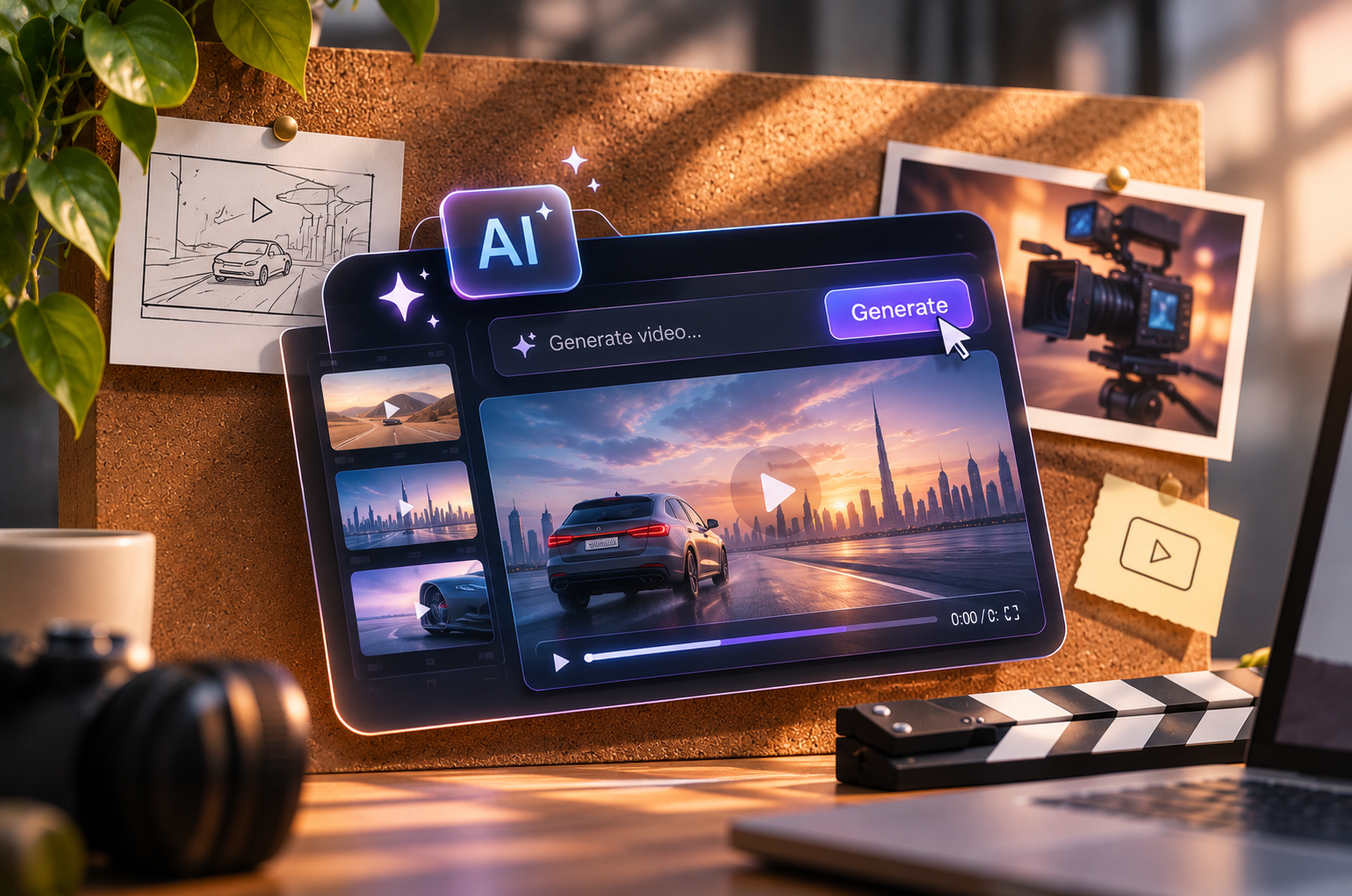
For years, creating a social video meant having a camera, a location, a production team and several rounds of editing. Now, it can begin with a prompt. A sentence can become a scene. A still image can become a moving asset. A digital presenter can be created without a casting call. An impossible product demonstration can be visualised without ever happening in the real world. Generative AI has changed what is technically possible in social video.
But that creates a more interesting question for brands:
Does AI-generated video actually perform better, or does it simply make it easier to produce more content?
The answer isn’t straightforward. AI can make video faster, cheaper and more scalable. It can also produce extraordinary visuals that would be difficult or expensive to create traditionally. But social media has never rewarded production value alone. And as AI-generated video becomes increasingly common, simply being impressive may no longer be enough. AI has solved the production problem. It hasn’t solved the creative one.
One of the biggest advantages of generative AI is obvious: it lowers the barrier to producing video. Brands can create multiple visual directions, test different concepts, generate versions for different audiences and adapt content across formats without starting production from scratch every time. That is a significant shift. But there is a danger in making production too easy.
When a brand can create 20 videos instead of two, it is tempting to believe it has become 10 times more creative. It hasn’t. It has simply become 10 times faster at making decisions.
And if the underlying idea isn’t strong, AI can make the same weak idea look polished at unprecedented speed. This is where the growing conversation around low-quality, mass-produced AI content becomes relevant. The social feed already has more content than people can possibly consume. AI adds another layer of volume. So the competitive advantage isn’t necessarily making more. It is knowing what is worth making.
The most interesting AI video isn’t always the one made by AI
One of the strangest examples of AI’s influence on social video happened with MrBeast.
The story started in 2024 with a Russian song whose lyrics were misheard by English-speaking audiences as something resembling “MrBeast rizz.” The sound became associated with AI-generated videos of MrBeast dancing, many created using tools such as ViggleAI.
The artificial versions became a meme. Then, two years later, MrBeast recreated the meme himself. In August 2026, he posted a real-life version of the dance on TikTok, complete with the distinctive choreography and backup dancers wearing masks of his face. According to Know Your Meme, the video passed 266 million views, 33.2 million likes and 1.6 million comments within nine days. It was also reported as the most-reposted TikTok at the time. And there is an especially funny twist.
Some viewers assumed the new video was AI-generated because the movements looked so much like the earlier synthetic versions. MrBeast subsequently posted behind-the-scenes footage showing the real production.
The sequence is almost perfectly backwards:
AI created the imitation → the imitation became a meme → the real person recreated the imitation → the real version became massively viral.
This is important because it challenges the simplistic idea that AI will simply replace human-created social content.
Sometimes, AI becomes the starting point for human creativity. People can react to an AI video, recreate it, parody it, improve it or bring it into the real world. The technology creates the stimulus. The human response creates the next piece of content. And the MrBeast example shows just how powerful that loop can become.
AI can create the impossible. Humans can make it worth watching.
There is a reason human recreations of AI trends can work so well. The audience isn’t simply watching the result.
They are watching the attempt.
There is effort. There is personality. There is uncertainty. There is the satisfaction of seeing whether a person can actually reproduce something that originally existed only inside a generated image or video. That adds a layer AI-generated footage doesn’t automatically have.
It also creates a new kind of social storytelling:
AI creates → people react → creators recreate → audiences compare → the idea evolves.
For brands, this is a much more interesting opportunity than simply producing an AI-generated advertisement.
Instead of asking, “What can AI make for us?”, brands can ask:
“What will people do with this idea?”
That opens the door to participation, remixes, creator responses and user-generated content. The AI asset becomes the beginning of the conversation rather than the finished product.
But sometimes AI-generated video does win
None of this means human-made video automatically performs better.
The evidence is much messier.
One useful example comes from Cadbury Creme Egg.
For its 2024 campaign, the brand created multiple versions of its “How do you eat yours?” creative in different formats and lengths. YouTube’s AI-powered advertising tools then helped determine which creative to show to different viewers based on factors including demographics, interests and viewing behaviour.
The result was not simply more content. It was more relevant combinations of content and audience.
According to Google, the campaign tripled its reach year-on-year, achieved a 45% video completion rate, increased its key “meaning” metric by 9%, and achieved a two-year low in CPM.
The important part is what actually drove the result. AI wasn’t replacing the creative idea. The brand created the different creative possibilities. AI helped decide who should see what. This is a much more useful way to think about AI in social video.
The future may not be one video for everyone. It may be many versions of one idea, intelligently matched to different people.
This is where AI-assisted video may matter more than AI-generated video
There is a tendency to group everything under “AI video.”
But there is a huge difference between:
AI-generated video:
The machine creates much or all of what appears on screen.
AI-assisted video:
AI helps with elements such as ideation, visual development, editing, localisation, versioning or production.
AI-powered distribution:
AI determines which creative, format or message should reach which audience.
Those three applications have very different implications.
Under Armour’s Forever Is Made Now campaign featuring Anthony Joshua, for example, used AI alongside 3D, CGI, VFX, motion graphics, editing, sound and other production techniques. The brand said the film allowed it to tell a specific story around Joshua’s mindset while he was preparing for his fight, without physically accessing him during his preparations.
The result was not simply “an AI video.”
It was a hybrid production in which AI was one of several creative tools.
That distinction matters because AI doesn’t have to replace traditional production to create value. Sometimes it simply expands what the production team can do.
The problem with measuring AI video through views alone
AI-generated content has a built-in advantage when it comes to curiosity. People want to see what the technology can do. That can produce an enormous number of views.
But there is a difference between: “I need to see this.” and “I actually care about this.” A viewer might watch an AI-generated celebrity because they can’t believe it is real. They might comment because it looks strange.
They might share it to ask someone, “Is this AI?” All three actions can create engagement. None necessarily means the brand has built a positive association. This makes measurement particularly important.
For AI video, brands should look beyond views and track:
- Watch time
- Completion rate
- Shares and saves
- Engagement rate by view
- Sentiment
- Brand recall
- Brand lift
- Click-through rate
- Conversion
- Incremental sales, where measurable
And there is another comparison worth making:
How does the AI version perform against a strong human-made version of the same idea?
That is a far more useful test than comparing AI content with no alternative. Coca-Cola shows why attention and approval aren’t the same thing Coca-Cola’s 2024 Christmas campaign is a useful example of this distinction.
The brand used generative AI and digital tools to reimagine elements of its iconic Christmas advertising world.
The campaign attracted substantial attention. An analysis published by the Economics Observatory found that the 2024 AI Christmas ad accumulated around 7.9 million YouTube views, more than several previous Coca-Cola Christmas ads.
But engagement quality told a different story. The analysis found approximately one like per 1,000 views for the 2024 AI ad, compared with around 9.6 likes per 1,000 views for the 2023 campaign. The takeaway isn’t that the campaign “failed.” It is that a large view count doesn’t tell you whether people actually liked what they watched.
For marketers, this distinction is crucial.
AI can generate attention. The creative still has to earn affection.
The authenticity problem gets harder as AI gets better
Ironically, one of AI video’s biggest problems may disappear as the technology improves.
The awkward hands.
The strange faces.
The unnatural movement.
The obvious visual glitches.
These are getting harder to spot.
And that creates a bigger issue.
Trust.
If audiences can’t easily tell whether a person, testimonial, product demonstration or event is real, brands need to think carefully about how much synthetic realism they actually want.
Vodafone experienced a small version of this with a 2025 TikTok ad in Germany featuring a digitally generated presenter.
Viewers noticed strange details in the woman’s appearance and questioned whether she was real. Vodafone confirmed in the comments that the presenter had been created using generative AI.
The ad certainly got attention.
But much of that attention focused on the question of whether the presenter was real rather than the message she was delivering.
That is the uncanny valley problem in social advertising:
When the technology becomes more interesting than the idea, the technology wins the attention and the brand can lose it.
There is also a difference between synthetic creativity and synthetic evidence
One of the clearest warnings about AI and trust came from the 2025 Cannes Lions controversy involving Consul’s “Efficient Way to Pay” campaign. Cannes Lions withdrew the campaign’s Creative Data Grand Prix after discovering that AI-generated and manipulated material had been used in its case film to simulate real-world events and campaign outcomes.
The problem wasn’t simply that AI had been used. The problem was that generated material had been presented in a way that gave the jury inaccurate information about what had actually happened.
Cannes Lions subsequently introduced stronger transparency and integrity measures around AI-generated material. That distinction is important for marketers.
AI can be used to visualise an idea. It becomes much more problematic when it is used to manufacture evidence that something happened. As synthetic media becomes harder to distinguish from reality, provenance becomes part of creative responsibility.
The real opportunity may be experimentation
There is a more exciting way to think about AI video.
Not: “AI lets us make videos cheaply.” But: “AI lets us learn faster.” A brand can create multiple hooks. Test different visual worlds. Develop different edits. Localise content. Create different product demonstrations. Adapt a campaign for different audiences. Test whether a particular message works better as a six-second video or a 20-second story.
That can fundamentally change the creative process.
Instead of spending most of the budget producing one version and hoping it works, brands can potentially move towards a more iterative model:
Create → test → learn → adapt → create again.
The advantage isn’t necessarily that every piece of content becomes better. It’s that the brand can discover what works faster.
But infinite testing can create its own problem
There is a trap here too. Once AI makes variations cheap, marketers can become obsessed with optimisation.
- Different colours.
- Different hooks.
- Different faces.
- Different backgrounds.
- Different CTAs.
- Different lengths.
But none of those matter if the proposition itself isn’t interesting.
You can A/B test a mediocre idea 50 different ways. It will still be a mediocre idea. AI makes optimisation easier. It does not make judgement unnecessary. In fact, it makes judgement more important.
The human role is changing, not disappearing
The more capable AI becomes at producing the execution, the more valuable the human decision behind the execution becomes.
Someone still needs to decide:
- What should we say?
- Why should anyone care?
- What should this audience feel?
- What should they remember?
- Does this actually feel like our brand?
- Should we use AI here at all?
Those are strategic and creative decisions.
And they become even more important when the cost of producing the wrong answer approaches zero.
So, should brands make AI-generated videos?
The better question isn’t whether a brand can use AI. It is whether AI creates an advantage that the audience can actually experience.
Before making an AI-generated social video, ask:
- Does AI make the idea better?
If the idea works just as well without AI, the technology may not be adding anything meaningful.
- What does the audience get from the AI?
Is it an impossible visual? Personalisation? Participation? A new experience? If the only benefit is lower production cost, that is useful for the brand but invisible to the audience.
- Could a human version perform better?
The MrBeast phenomenon is a useful reminder that audiences can become fascinated by the human recreation of something AI created. The technology isn’t always the final destination. Sometimes it is the prompt.
- What happens when people know it’s AI?
If transparency makes the content more interesting, great. If it makes people question the brand’s authenticity, that’s something to consider before publishing.
- What are we actually measuring?
Don’t let a large view count become a shortcut for effectiveness.
Measure attention, engagement quality, brand impact and business outcomes according to the objective.
AI doesn’t kill the human idea. It raises the bar for it.
The biggest shift brought by generative AI isn’t that machines can now make videos. It’s that making the video is becoming less of a barrier to having an idea. That changes the creative game. Production becomes faster. Experimentation becomes cheaper. Personalisation becomes more achievable.
But the feed doesn’t suddenly become more interesting just because the technology becomes more powerful. If anything, the opposite happens. When everyone can generate something spectacular, spectacular becomes the baseline. The advantage moves back to the thing AI can’t automatically decide:
What is worth making?
The most successful brands won’t necessarily be the ones generating the most AI video. They’ll be the ones that know when to generate, when to assist, when to personalise, when to stay human and, perhaps most importantly, when not to use AI at all. Because social media doesn’t reward the technology behind the content. It rewards what people choose to watch, remember, share and act on. And that part of the equation is still very human.
How Outreach Advertising can help
At Outreach Advertising, we see AI as a creative and strategic tool, not a substitute for the thinking that makes content worth watching.
From social-first concepts and AI-assisted production to audience insights, creative testing, content adaptation and performance optimisation, our approach is to identify where AI can create a genuine advantage for a brand and where a human-led execution will make the stronger connection.
Because the question isn’t simply whether your brand can use AI.
It’s whether AI can help you make better work, reach the right people and create results that matter. Want to explore what AI could do for your brand’s social content? Talk to Outreach Advertising.
Related Posts

- Outreach
- December 20, 2024
Customer Lifetime Value (CLV): Why It Matters and How to Maximize It
In today’s cutthroat business world, focusing on Customer Lifetime Value (CLV) is a game-chan ..

- Outreach
- September 20, 2024
Crisis Management in Digital marketing Advertising: Tips for Handling Brand Crises Online
In the age of instant communication, a brand crisis can escalate in mere minutes. Whether it’ ..